Where "it works on my machine" came from
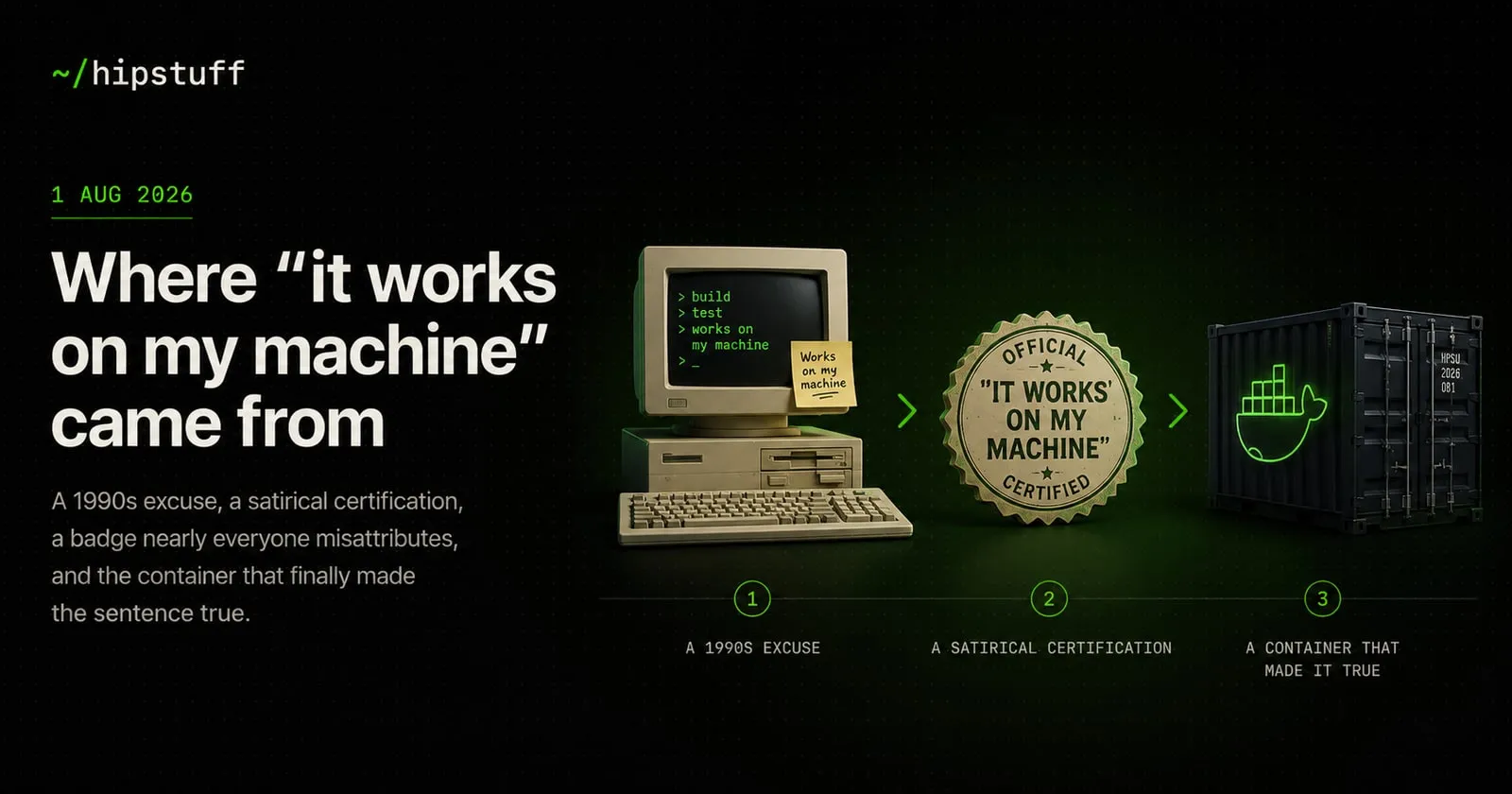
Every developer has said it. Most have had it said back to them, usually while looking at a stack trace that the other person swears they cannot reproduce.
It is the most quoted sentence in software, and its own history turns out to be a mess of misattribution — which, for a joke about reproducibility, is funnier than it has any right to be.
Nobody knows who said it first
There is no origin. The phrase was in ordinary use through the 1990s, in newsgroups and bug trackers and hallways, and no one thought to write down who said it first because it wasn’t a joke yet. It was just a fact about how software worked.
That’s the necessary background: for most of computing history, the sentence was true and unremarkable. Environments genuinely did differ. You had a machine, your colleague had a different one, and there was no shared substrate to appeal to. Saying “it works on mine” was a data point, not a defence.
It only became a punchline once reproducibility started to seem achievable.
The certification that made it a joke
On 1 February 2007, a developer named Joseph Cooney published a satirical piece proposing a “Works on My Machine” certification programme — a mock quality standard, complete with steps you had to complete to earn it. Compile the code. Run it once. Ship it.
Six weeks later, on 15 March 2007, Jeff Atwood wrote about it on Coding Horror and designed the badge: a green seal in the visual language of a real certification mark, released under Creative Commons so anyone could slap it on anything.
The badge went everywhere. It is still on README files today.
And here is the thing almost every retelling gets wrong: Atwood made the badge, Cooney made the joke. Search for the origin and you will mostly find Atwood credited with both. The design travelled and the text didn’t, which is its own small lesson about how ideas propagate.
“Then we’ll ship your machine”
The famous rejoinder — “it works on my machine” / “then we’ll ship your machine” — is universally attributed to Docker, and often specifically to Solomon Hykes.
I went looking for the source. There isn’t one.
It appears in conference slides, in blog posts, in Docker tutorials, in countless talks, always stated as though it came from somewhere. What it does not appear in is any primary source. Hykes unveiled Docker in a lightning talk at PyCon 2013, and the line seems to have accreted around the project afterwards rather than being said by anyone in particular.
So the most-quoted exchange in DevOps has one half from 1990s folklore and the other half from nobody at all.
Docker did actually fix it
The joke’s second life is the interesting part, because the punchline stopped being a punchline.
Containers made “it works on my machine” literally true and also sufficient. If your machine is a container image, shipping your machine is the deployment strategy. The excuse became the architecture — and the orchestration layer that grew on top of it went on to acquire a logo with a Star Trek joke hidden in it.
That’s a rare thing. Most engineering jokes are about permanent conditions — estimates are wrong, naming is hard, the last bug is never the last bug. This one had a solution, the solution arrived within a working career, and the joke survived anyway as a kind of fossil. People still say it. They mostly say it now about CI runners, or about the one colleague on a different architecture.
Why it still lands
Because the underlying condition never fully went away, it just moved.
The container is reproducible. The host kernel isn’t. Neither is the CPU architecture, the filesystem case-sensitivity, the locale, the timezone, the DNS resolver, or whatever your laptop is doing with file watchers that the build server is not. Anyone who has watched a green CI pipeline fail on one developer’s ARM laptop knows the sentence is still doing useful work.
We didn’t eliminate the class of problem. We pushed it down a layer, which is what software mostly does with problems.
The unreproducible meme
Set it out end to end and there’s a pleasing symmetry:
- The phrase has no documented first use
- The certification is usually credited to the wrong person
- The famous reply has no source at all
- The product that solved it is credited with a line it may never have said
A meme about the difficulty of reproducing things, whose own provenance cannot be reproduced. Nobody planned that, which is the best kind of joke.
The sentence outlived its problem, kept its shape, and lost its history along the way — which is roughly what happens to any phrase good enough to survive thirty years of people repeating it without checking.